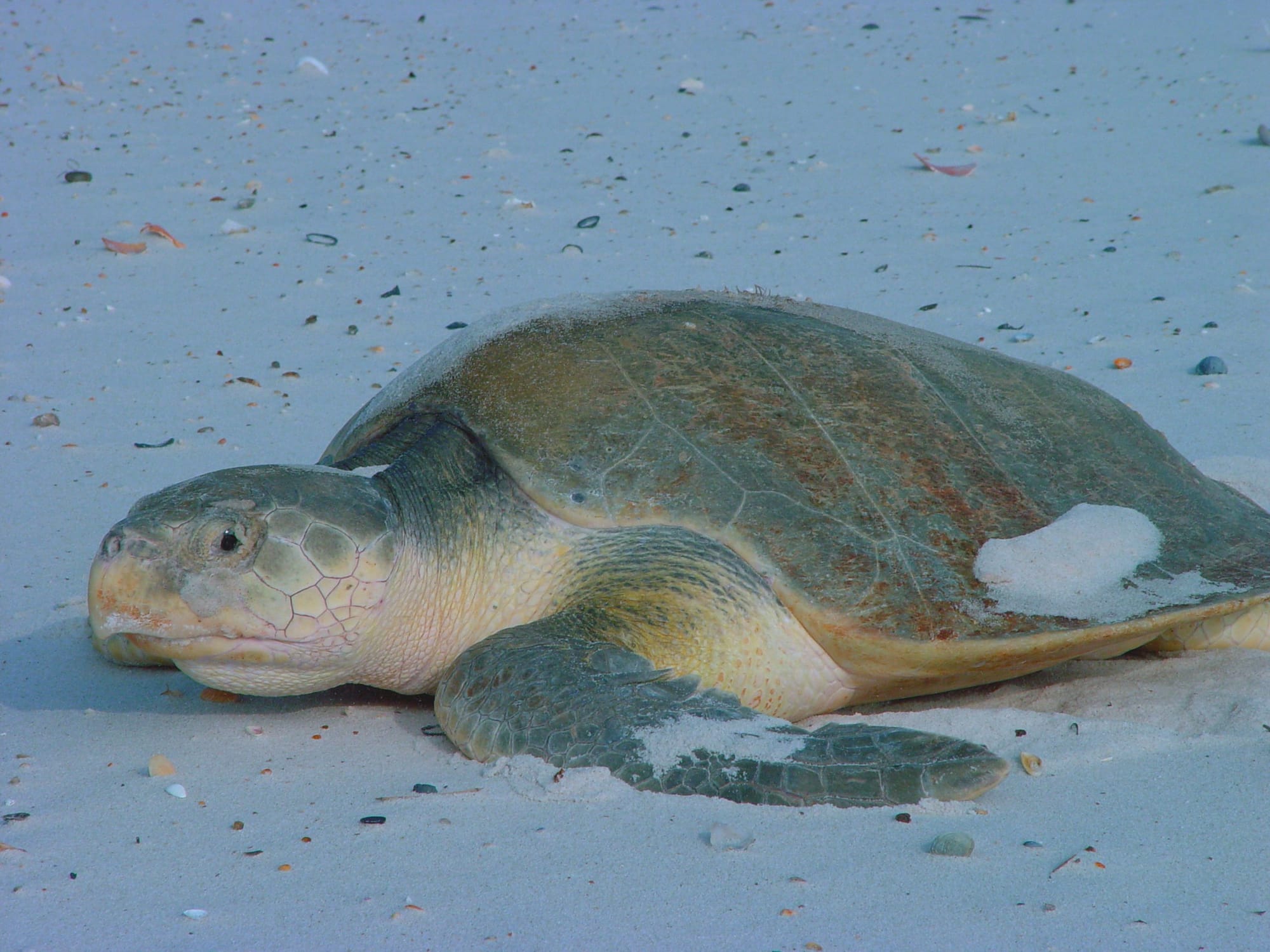

It is the 1950s. You are Archie Carr, a herpetologist in Florida with a particular interest in sea turtles, their nesting, and their habits. You’ve already learned a lot about the different species that call your state home, but there is one particular mystery that continues to elude you and even drive you crazy at times: the nesting grounds of the Kemp’s ridley sea turtle.
The Kemp’s ridley is the smallest of the 7 sea turtle species and is found foraging in the waters off of Florida as well as throughout the Gulf of Mexico and Caribbean Sea and up the Atlantic seaboard. Many of them get cold stunned in the autumn up north if they take too long to migrate back to warmer waters after summer feeding. Cape Cod, Massachusetts in particular acts as a physical trap for migrating turtles at times.
However, while seen frequently, no scientist has ever seen a Kemp’s ridley nesting. Sea turtles, being reptiles, cannot breathe water and their eggs cannot either. That is why they must come up onto beaches to nest. Nesting beaches are known for the other six species, some of them catalogued in detail by you personally, but there has been no sign of a Kemp’s ridley nesting beach.
Some biologists and fishermen believe it to be an infertile hybrid, a ‘mule of the sea’, the product of the mating of two different sea turtle species, perhaps a loggerhead and a green turtle. A bastard turtle. You are not convinced. The search for the ridley nesting grounds drives you. At times it feels like the quest for El Dorado, something out of myth and fable rather than science and fact.
You and your colleagues have already surveyed much of Florida and confirmed that no Kemp’s ridleys nest there. Mostly loggerheads and greens, with a few leatherbacks in specific locations. What do you do next?
Track an adult turtle to the nesting grounds
This idea is not just infeasible, but borders on insane. You’re thinking with your modern brain where tracking via satellite is commonplace. Sputnik, the very first artificial Earth satellite didn’t launch until 1957. Tracking of a sea turtle at the time you are working is done visually. Keeping track of a creature that swims is even more difficult than keeping track of one that flies. Migrations to nesting beaches from foraging grounds can be hundreds (or thousands) of kilometers long and adults don’t nest every year. The turtle you choose to follow might not nest for two years even if you could keep track of it.
Look for hatchlings and focus your search there
An interesting idea, but a non-starter. At this point in time, no one knows where hatchlings go after they return to the ocean. They leave the beach immediately and then are not seen again until they are juveniles the size of dinner plates. You personally call it the ‘lost year’, though the actual amount of time is also unknown. Finding a hatchling in the ocean of a more common species like a loggerhead hasn’t been done yet, so finding a Kemp’s ridley hatchling is far-fetched.
Survey farther north (Georgia and the Carolinas)
Each choice takes time and effort and sea turtles do not nest year-round. Picking one location often means having to wait to survey the other until next year. The species composition of nesting sea turtles in these states is somewhat similar to Florida, though with fewer greens and almost no leatherbacks. The vast majority of nesting sea turtles here are loggerheads. No one has seen a Kemp’s ridley nest here.
Survey the Gulf coast
Each choice takes time and effort and sea turtles do not nest year-round. Picking one location often means having to wait to survey the other until next year. There are sea turtles nesting in the non-Florida states along the Gulf, though not in as high numbers. Almost all of them are loggerheads. No one has seen a Kemp’s ridley nest here.
You must expand your search farther afield. Thankfully, Kemp’s ridleys seem confined primarily to the North and Central regions of the Eastern Atlantic, so at least you don’t have to look worldwide.
Survey the Caribbean islands
It seems simple at first. Until you realize that there are over one hundred major islands in the Caribbean sea. Some are quite small, only a few dozen kilometers of coastline to survey, but larger islands like Cuba and Hispaniola (the Dominican Republic and Haiti) have thousands of kilometers between them. The islands seem to be much more of a hotspot for hawksbill nesting than mainland North or Central America, but you don’t find any Kemp’s ridley nests or anyone who has seen one.
Survey Mexico and Central America
There’s a major green sea turtle nesting beach at Tortuguero, Costa Rica. You started an ongoing population survey there in 1954. It’s illustrative of the challenges you are having in this search. The area is inaccessible except by boat or small plane. Many of the beaches in this part of the Caribbean are similar. You try your best, but still find mostly green and leatherback nesting sites, with a few loggerhead, or hawksbill locations. Still no ridleys.
This does not seem to be an efficient use of your time. There are too many beaches to check and many of them are difficult to access. There must be a way to multiply your efforts.
Train your students to take on some of the surveys
You’ve already been doing this, of course, but it’s time to step it up. This search cannot be conducted by one person. Besides, eventually you will be gone and you need people to continue your population surveys and conservation work. Unfortunately, there is a trade-off to this. It means less time you can allocate to personally being in the field, something in which you find immense joy and wonder. You’ll just have to suck it up. Trade-offs are a part of this work too.
Collaborate with your colleagues
No one person is an island unto themselves. You are not the only scientist working on this mystery. Some researchers can be prickly and territorial about their work, but in the end you still share your data with each other. Coordination and cooperation will go a long way to making sure you aren’t retreading the same ground as one another in your search.
This is a good start but how else can you broaden your search?
Ask local people if they have seen nesting Kemp’s ridleys
An excellent idea. Often times, those living near natural areas will understand them better than outsiders. However, there are limits to local knowledge. Sea turtles tend to nest at night, when most people are asleep, though they leave their telltale tracks in the sand as proof of their presence. Furthermore, local people may not be able to tell the difference between species of sea turtles. Some are easier (no one could mistake the gigantic form or tracks of the leatherback for a smaller turtle) but others are more subtle and difficult to tell apart even for experts. Still, while this questioning often elicits the presence of sea turtles and not the specific species, it still greatly accelerates your surveying ability.
Coordinate with local governments
Many local officials are corrupt. Others mean well but are more focused on economic issues than scientific ones. Eventually, some of these efforts will pay off for sea turtle conservation, but they do not assist you in finding the Kemp's ridley nesting grounds.
After years of work and nothing to show for it, a breakthrough finally comes. Is it…
On a nesting beach you haven’t checked yet
Unfortunately, you again find one of the other four species of sea turtles in this part of the world and no sign of Kemp’s ridleys.
At the Annual Meeting of Ichthyologists and Herpetologists
It is 1961 and a colleague of yours, Henry Hildebrand, who has been working extensively in Mexico and sharing his interest in Kemp’s ridleys to the locals there arrives at the symposium with a videotape. Filmed in 1947 by a Mexican pilot, Andrés Herrera, your colleague’s relentless pursuit eventually put him in contact with a friend of the filmmaker and then the man himself. The video is a sensation, thousands of turtles nesting at once, some of them practically on top of one another. Even more astonishing, they were nesting in daylight, something almost unheard of in other sea turtle species.
The Mystery of the Bastard Turtle was solved, but why had it been so difficult? It turns out that a near perfect set of factors had contributed to the Kemp’s ridley nesting grounds remaining hidden. The primary beach was near Rancho Nuevo, Mexico in the state of Tamaulipas, a highly remote area. Like their cousins the olive ridley, the Kemp’s exhibit a unique nesting strategy called an arribada. Instead of nesting individually over the course of several months, the entire nesting population comes ashore over a few days. The idea is to overwhelm any potential predators of either the nesting females or the hatchlings. The man who had gotten the videotape had filmed nothing on that beach for over three weeks before he got the arribada footage. He was an engineer, not a biologist, and so did not understand the significance of his find until approached by Hildebrand over a decade later.
Collaboration and cooperation had been key to finding the nesting turtles, along with precise timing and luck. Furthermore, each year, the spectacle diminished as egg poaching and the death of grown turtles in fishing and trawling nets took their toll. It became easier and easier to miss the event. Over the following years, a few more isolated Kemp’s ridley nesting beaches are found, all on the Gulf Coast, but none compare to the numbers nesting at Rancho Nuevo.
You are able to visit Rancho Nuevo after the video comes to light, but there are only about 2,000 nesting turtles instead of the 40,000 from before. Your work isn’t done. You have finally found the Kemp’s ridley nesting beach, but now you and your colleagues have to work to ensure the species can come back from the brink of extinction.