
Death Valley. It’s the hottest place on Earth, but also a chance for riches if you’re tough. The year is 1915 and your name is Joseph Crook. You aren’t a scientist, but a miner and a prospector from Nevada. You aren’t interested in the lowland areas with their unbearable heat, but the mountains surrounding them. That’s where valuable ore can be found: gold, silver, and copper mostly.
However, scouting those areas for ore veins sometimes requires you to walk along the edges of the valleys. This has brought you today to a dry lake and, though you do not know it yet, your place in history.
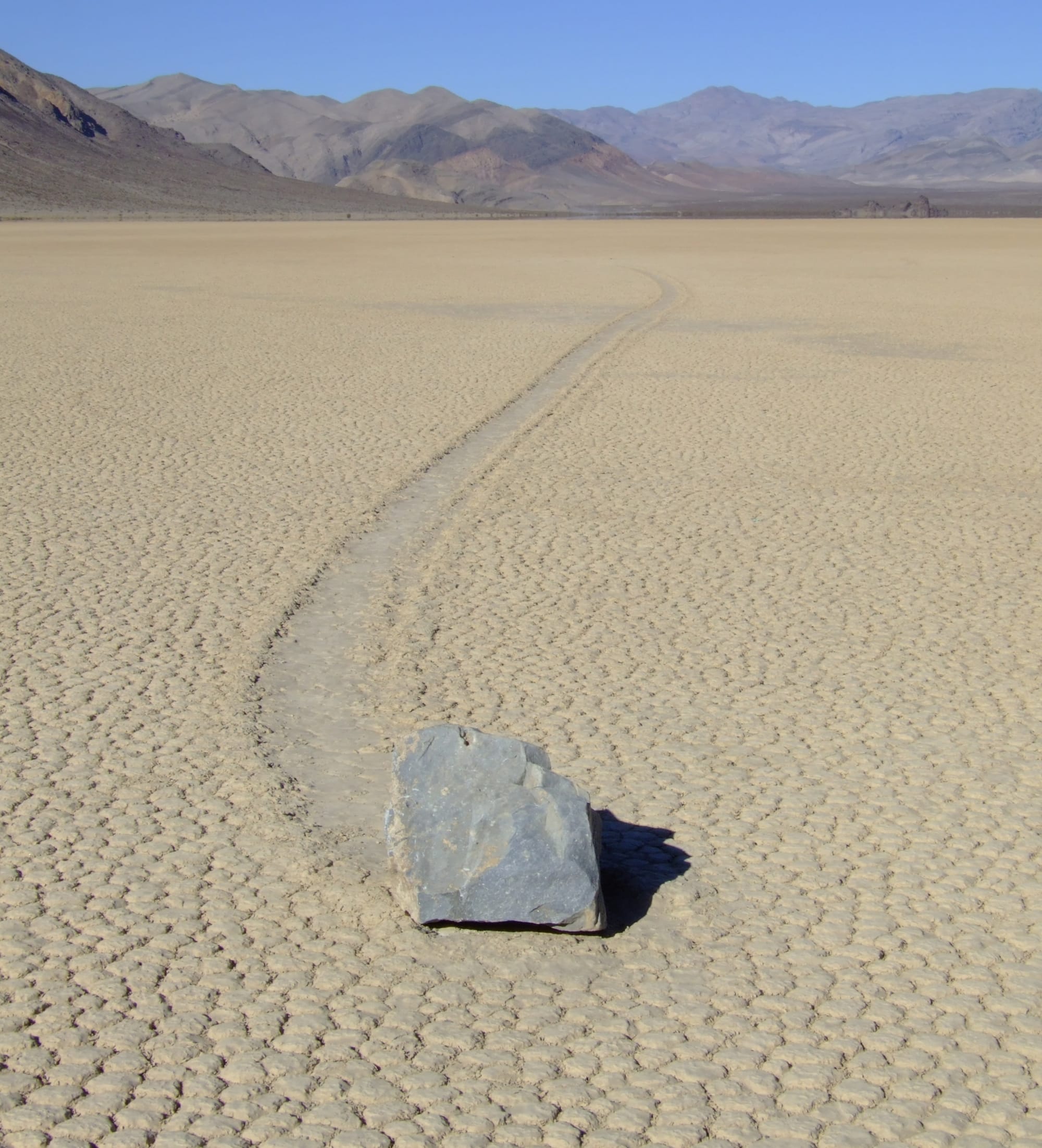
The ore survey is disappointing. While there are valuable mines elsewhere in the area, you don’t see any evidence of a worthwhile vein here. Your feet crunch on the ground, which is cracked in six-sided shapes about 3 to 4 inches across. The mountains surrounding this place act like a funnel and the wind whips at you. Then, you notice something strange: tracks. Not of any animal, but long furrows through the ground. You decide to follow one and it ends in a large stone. You follow several more, each one ends in a similar large stone, each between about 6 and 18 inches across. While some of the tracks were straight lines, others would occasionally veer off from their original direction.
The strangest thing about these furrows are the lack of tracks along their length. In fact, other than your own footprints, there are no tracks on the dry lake bed at all. This doesn’t surprise you, as places like this are known to be inhospitable, with no water, vegetation, or animal life. It certainly looked like no person or animal was pushing these boulders. How then could they move?
Of course, for you these furrows were merely a curiosity. You move on to look for ore in other places, but pass on word of your strange sighting to your friends.
For the next thirty years, mostly through word of mouth, prospectors and even tourists would go to see the strange stones at the ‘Racetrack’. The first scientific survey of the area was conducted by geologists Jim McAllister and Allen Agnew in 1948, but their work touched only briefly on the possible mechanism of movement.
Interest in how the sailing stones of Death Valley moved began to pick up in the 1950s. The dry lake was named Racetrack Playa. The stones only seemed to move during the winter and did not always do so every year. Which explanation do you favor?
Wind
A strong possibility and the explanation put forth by McAllister and Agnew. Wind speeds in the area can easily top 50mph or more, creating dust devils. However, some of the boulders are massive, over 700 pounds, and likely would need hurricane force winds to move them.
Aliens/UFOs
A popular explanation for unexplained phenomena around the world, but not for scientists. Remember that you want to start with simpler explanations before moving on to ones that require more assumptions (Occam’s Razor). Think about what assumptions this explanation would require. Does it really seem like a reasonable starting point?
Algae Mats
The area only receives 3 inches of rain a year, mostly in the winter months. Throughout the world, dry places are seen to come alive after the rain. If this happened at Racetrack Playa, perhaps a large bloom of algae or microorganisms grew on the surface of the lake, allowing the stones to slide across.
Ice
While Death Valley is known for its extreme heat, like many deserts it also exhibits extreme cold at night. Thus when it does rain, the thin layer of water can freeze, possibly increasing surface area to catch the wind or creating ice floes that move the stones.
Hoax
It certainly wouldn’t be the first or the last trick played on people by creative pranksters. However, the remote and inhospitable location combined with the complete lack of human footprints or vehicle tracks makes this explanation implausible.
Magnetic Fields
It’s possible that some property of the Playa or the stones might cause increased magnetic forces to propel the stones across the surface, but geological analysis of both has shown no evidence of such unusual magnetic attraction or repulsion. The stones are mostly syenite and dolomite, not magnetic by themselves, though iron or magnesium impurities present in the rock can make them so. However, the Death Valley stones do not possess such impurities in sufficient quantity to explain their movement.
The first extensive study of sailing stone movement began in 1968 and lasted for seven years. You are geologists Bob Sharp and Dwight Carey, the study authors, how do you approach such a challenge?
Monitor the Playa in person
This is both impractical and dangerous. The extreme temperature shifts and lack of water and food make prolonged in-person monitoring impossible. Both scientific equipment and all of the necessary items for survival would need to be brought out to the middle of a remote National Park. While the closest dirt road at the time was only half a mile away (not that long a walk for a seasoned field researcher) the nearest paved road was 27 miles away and the closest food, water, fuel, and medical care was 80 miles away. In an era with limited communication possibilities, such a risk would not have been worth it.
Film the Playa
Camera and film technology are undergoing important advances at this time, but the remote location of the research means that it has not caught up with the specific difficulties posed by the sailing stones. Time lapse photography became possible, but would be limited by the amount of physical film a camera could contain. Still cameras would run out in days and the batteries required to run a film camera would quickly die in the extreme conditions of the study site. Not to mention the fact that the sailing stone movement seemed to be connected with the winter rains in some way, meaning that the cameras could be easily damaged by the weather or knocked over by the wind.
Set up experiments that you can check on
It’s a bit more complicated and gives only small glimpses of the phenomenon as a whole, but at the time it’s the only way to be able to monitor the long-term movements of the stones. You end up labeling the stones and setting up stakes to help track their movement. You revisit the area 2 or 3 times a year, usually at the beginning and end of winter. You are able to calculate distance and direction and set up corrals to test the ice floe hypothesis. The rebar of the corrals was not disrupted or moved, indicating that if ice is a factor, it must be in small pieces around the rocks.
Heavy winds and thick ice to reduce friction are still the leading hypotheses, but the exact mechanism is elusive. Work continues on narrowing down the exact way in which the physical and meteorological factors contribute to the stones’ movement.
In the early 21st century, technological breakthroughs in digital photography make monitoring the sailing stones a simpler task. Time lapse cameras now have the storage capacity to capture images over longer periods of time. This is important because the stones do not always move every year and each movement event is hypothesized to last a few seconds. However, this breakthrough introduced a new complication: the vast amount of photos produced by such methods. How would you deal with that?
Set the camera to time lapse and examine each photo
At this point you still don’t know how long the stone movements last, you need to set your exposures to small time intervals to make sure you capture what you’re looking for. If it takes a photo once every second, that is 86,400 over the course of only one day, more than 2.5 million per month. It might take a whole year for one person to review the photos from a single three-month research window.
Find a way to trigger the camera only when a photo you want is more likely
For example, trail cams use motion sensor technology so that they only take pictures of wildlife and not of empty trail. But what would work for the sailing stones? Their motion is a bit more subtle than an animal, so motion sensors might not trigger them. However, stone movement does seem correlated with wind, so when camera techs perfect wind-triggered imagery, you are able to narrow your search even more.
The final breakthrough occurs in 2014 with the combination of time lapse photography and attaching GPS trackers to the stones. The time windows for movement are indeed small, though not quite as small as originally thought by some. The longest recorded lasted 16 minutes. The ice and wind combination is shown to be correct, but not in the manner initially postulated. The movement does not occur from high winds or thick ice, but when the morning sun breaks up larger ice sheets that form at night into small pieces or ice panes around each rock only a few millimeters thick.
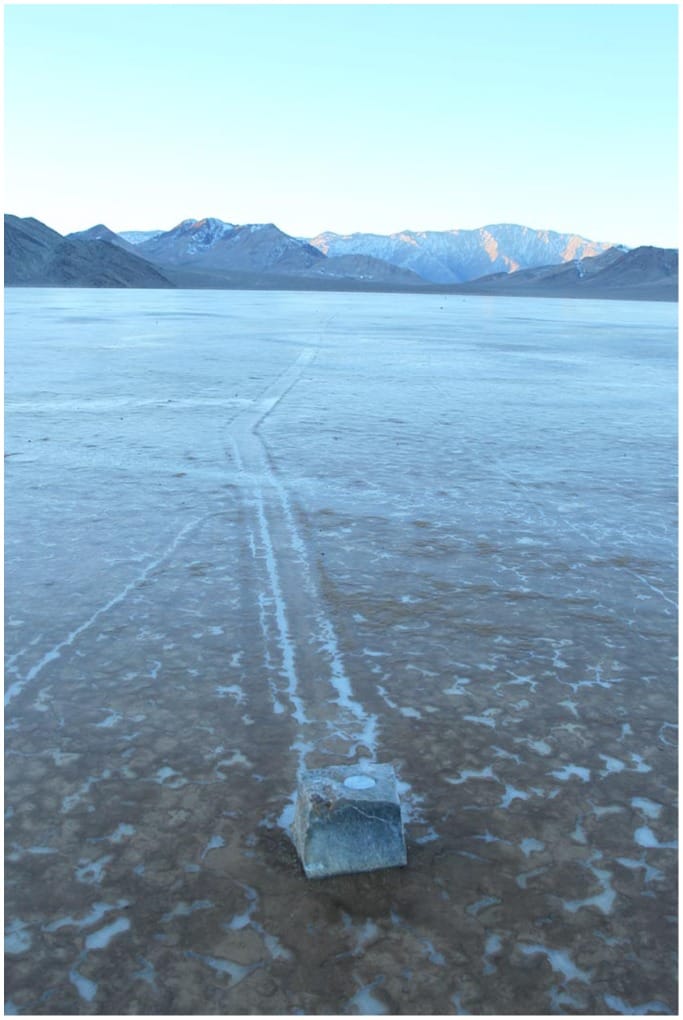

Land heats faster than ice, creating a tiny layer of water between the ice sheet and the lake bed. This reduces friction and means that winds of only 10mph are needed to move the rocks. Such a phenomenon is sometimes called an ice shove or an ice surge and can also be seen on the shores of a frozen lake or ocean as ice is pushed by wind or ocean currents.
It is finally clear why the stones ‘sail’ and why that sailing is so rare (once every 3 years or even less often at times). The ice depth cannot be too thin or too thick or the rocks will not float. The morning after a rain must be sunny to break up the ice into small pieces, and the lake bed must be water saturated to further reduce friction.
The furrows of the sailing stones are thus the result of a confluence of physics and meteorology in a remote area with a unique environment and weather patterns. The most likely factors had been known for more than half a century, but the remoteness of the area that allowed for it to occur also meant that the specifics couldn’t be determined until we could get the equivalent of a spying eye in place to capture the stones as they moved.